Products


Key Eras in Honda Marine History
1. The Early Years (1964–1980s)
1964: The Debut: Honda launched its first outboard, the GB30, a 4-stroke engine at a time when the market was dominated by smoky, oil-discharging 2-stroke motors.
1967: Honda outboards entered the U.S. market.
Expansion: Throughout the 70s and 80s, Honda introduced smaller, portable models such as the B75 Twin (1971) and the BF75/BF100 (1980), demonstrating that 4-stroke engines could be compact and reliable.
2. Mid-Range & Performance Growth (1990s)
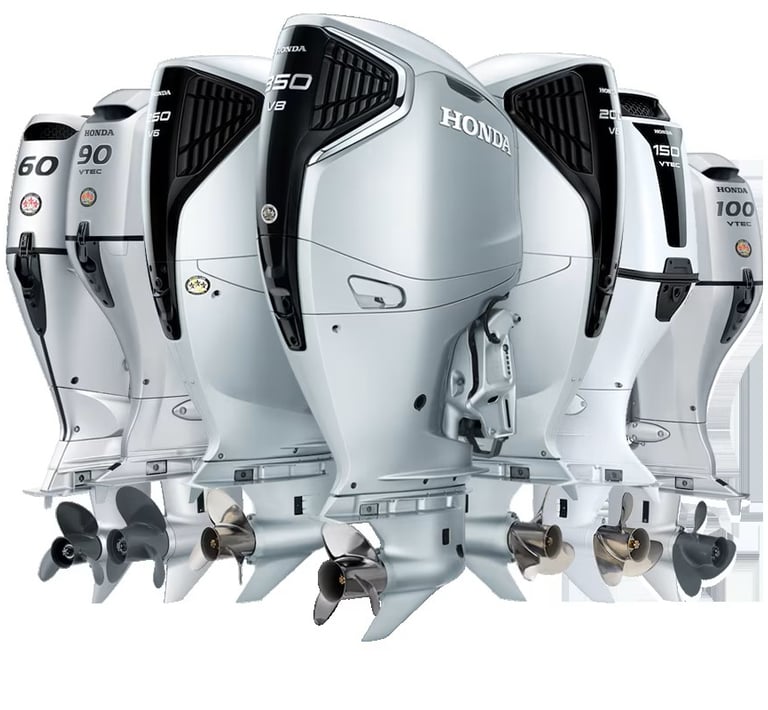
1990: New Design Language: Honda introduced the BF35A and BF45A, featuring a distinctive silver aesthetic that moved away from the traditional "square" look of outboards.
1995: Leveraging Automotive Tech: Seeking higher output, Honda used its expertise from the automotive sector to develop the BF75 and BF90, which were the first 4-stroke engines in their class. The BF90 won the Popular Mechanics Design and Engineering Award that same year.
3. Modern Innovations (2000s–Present)
Large Horsepower: Honda continued to push boundaries, eventually offering high-power models like the BF225 and BF250.
2024: The Flagship V8: Honda launched the BF350, its first V8 outboard, representing a major leap into the large-boat recreational market.
2025: Continued Expansion: At the boot Düsseldorf 2025 show, Honda premiered the BF300, a large-size outboard based on the BF350's V8 platform.
Why Honda Stuck with 4-Strokes
While competitors initially favoured 2-stroke engines for their light weight and low cost, Honda prioritised:
Environmental Impact: Avoiding the discharge of unburned oil into the water.
Efficiency: Offering significantly lower fuel consumption and quieter operation.
Durability: Building engines meant to last for both leisure and professional use.